Some years ago I began to use film as a pedagogical tool in teaching an elective class in housing history. It was the 1935 documentary about the slums in the East End of London Housing Problems that had first caught my attention – and subsequently those of my students.
I gradually introduced more films to the coursework – there are even films that give a discursive overview of specific topics, like Right to Buy and Homelessness. From a few films to supplement lectures the course grew and grew and became a new course ‘Housing and Film’. In collaboration with students there is now a repertoire of over 100 films which are used – though there are, of course, thousands more in the field.
A glance at the numbers opting for this course indicates something of the effectiveness of the adoption and use of film as a medium for this work, and my assessment is that the measure of the success can be accounted for under three interrelated rubrics:
- Pedagogical
- Historico – cultural
- Human comedy
On the pedagogical front, it is generally acknowledged how difficult it can be to get students to read these days – and housing texts, though still a fundamental and necessary part of the course, can be very dry. Furthermore, in an artschool (Glasgow School of Art) the emphasis the students are used to is always on the image and hands-on engagement. Mark Fisher wrote in Capitalist Realism of the ‘post-literate subjectivity of students’ who in the face of the emerging ‘entertainment-industrial complex’ find a pathological difficulty in leaving their digital affordances to concentrate on actually reading a book. In this context film certainly seems more student friendly.
On the historico-cultural front it could be said that it is not really clear cut that the digital culture has had a certain and distinct agency in leading us to this point of aversion to reading texts. Could the digital not also be said to have been just a means for arriving at a pre-existent desired destination? Back in the 80s, before the reign of digital culture, Jean Baudrillard was already writing of the return of western society to the culture of the image, where the erstwhile predominance of literary sources and text in general for cultural transmission is seen as simply a two-to-three centuries long detour. Our true culture, in this view, has always been driven by the image, and the digital has merely enabled a return home, as it were.
The third category – Human comedy – has arguably been the most important in the successes of the Housing and Film class – in terms of bringing students to engage with Housing History. My contention here is that film and television does for the British post-war Welfare Era what the great French novelist Honoré de Balzac did for Restoration and July Monarchy France. Housing is not just about buildings but is concerned with study of a set of relations between innumerable actors – tenants, owners and occupants first, of course, but also landlords, government, finance, land ownership and management, fiscal and housing policies, banks and local authorities as well as builders, construction companies, planning, design, raw material manufacturers and architects. In this context, housing films are figured as those that – operating like Balzac’s Comédie Humaine novels set in Paris 1830-50 – bring such a complex, incessantly changing set of human relations, their scope and their significance, to life in all its detail and colour.
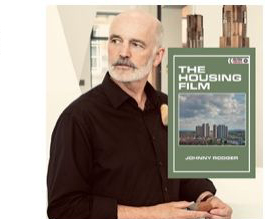 Johnny Rodger is a writer, critic and Professor of Urban Literature at the Glasgow School of Art. He has authored a number of published books, and his latest include The Housing Film (Edin Uni Press, 2024), Glasgow Cool of Art (The Drouth, 2022), Key Essays: Mapping the Contemporary in Literature and Culture (Routledge 2021), and Political Animal (Centre for Contemporary Arts, 2019). He writes regularly in press, magazines and journals, has made numerous TV and radio appearances and scripted films. He is co-founding editor of The Drouth literary arts journal. See more of his work here : Rodger, Johnny – RADAR