The University of Glasgow’s Centre for Robert Burns Studies (CRBS) is delighted to have launched a new Interactive Map of Burns Suppers Worldwide, celebrating 225 years since the first ever Burns Supper took place on 21st July 1801, the fifth anniversary of Burns’s death.
That first Supper was held at Burns Cottage in Alloway, Ayrshire, and it was attended by nine of Burns’s friends, patrons, and admirers, who commemorated him in a convivial setting by sharing a meal of haggis, reciting his poetry and songs, and raising a toast to the Immortal Memory of Scotland’s bard.
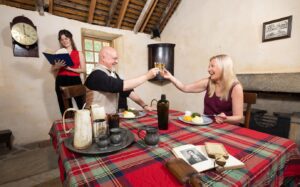
Inside Burns Cottage, site of the first ever Burns Supper. Left to Right: Dr Cleo O’Callaghan Yeoman, Christopher Waddell, Professor Pauline Mackay
Since then, this Scottish tradition has transformed into an annual celebration of Burns’s life and works and a global example of a Social Practice of Living Heritage – that is, ‘Living Heritage that is often shared and practised by a group’, including festivals, celebrations, and rituals (Living Heritage in the UK, 2025).
The Interactive Map of Burns Suppers Worldwide reflects this transformation. On it, over 1,000 Burns Suppers are recorded, taking place in 2026 alone, spanning all 7 continents and 76 countries.
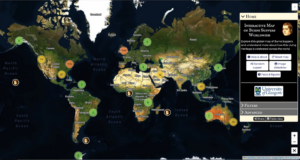
Image of the new Interactive Map of Burns Suppers Worldwide, accessible here
The Map Goes Live!
CRBS was delighted to partner with the National Trust for Scotland’s Robert Burns Birthplace Museum (RBBM) to launch the new map and deliver ‘The Burns Supper at 225 Years Open Day’ on Saturday 18th July 2026, attracting over 140 visitors.
An online map launch for the Burns Supper global community took place on Tuesday 21st July 2026, the official 225th anniversary.
Initial Findings
The Interactive Map of Burns Suppers Worldwide is a major output of ‘The Burns Supper at 225 Years: Scottish Tradition, Global Reinvention’ project, introduced on the SAHA blog earlier this year, which examines the ways in which the Burns Supper continues to be maintained, but also adapted and reimagined, by communities across the world. The dataset combines events submitted via CRBS’ global survey of the Burns Supper with events recorded by the project team using publicly available sources.
Initial analysis of the dataset reveals that many of the core elements of established at the 1801 Burns Supper are retained in the twenty-first century. Haggis, neeps, and tatties are served at 80% of recorded events on the map, Scottish whisky (or Scotch) is served at 88%, and Burns’s poems are recited at 74%. You can read more about the headline findings using the map’s ‘Facts & Figures’ function.
The map also records exciting examples of the tradition’s diversification, including culinary fusions such as haggis wonton and haggis poutine. There are Burns Suppers that are conducted in different languages, others that feature translations of Burns’s poems, and even some that celebrate Burns alongside other national poets, including the Sufi poet Rumi and the Romanian poet Mihai Eminescu.
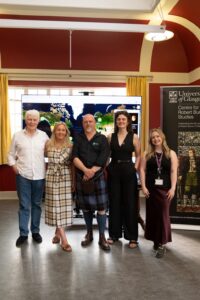
Image from the in-person launch at Burns Cottage, 18th July 2026. Left to Right: Bill Adair, Professor Pauline Mackay, Christopher Waddell (Learning Manager at RBBM), Dr Cleo O’Callaghan Yeoman, and Niamh Gilfillan (Learning Officer at RBBM).
Next Steps
Taken together, these snapshots create a rich and diverse picture of the Burns Supper as Global Living Heritage – one that continues to grow. CRBS’s survey of the Burns Supper remains live and will continue to accept new submissions on a rolling basis, with map updates scheduled for March and August each year.
If you would like to submit a Burns Supper, access the survey here, and send photographs, videos, and recipes for inclusion on the map to arts-burnssupper@glasgow.ac.uk. Multiple submissions are welcome and encouraged, and remember you don’t need to be the organiser or host in order to submit a Supper.
To learn more about the Burns Suppers as Living Heritage, as well as the different categories of Living Heritage encompassed in this tradition, please visit the project homepage.
To learn more about the Inventory of Living Heritage in the UK, and to read CRBS’ submission of the Burns Supper on behalf of and with support from the Burns Supper global community, click here.
Dr Cleo O’Callaghan Yeoman is Research Associate at the University of Glasgow’s Centre for Robert Burns Studies where she co-leads the project ‘The Burns Supper at 225 Years: Scottish Tradition, Global Reinvention’. Her research interests include Scottish Literature of the eighteenth and nineteenth centuries, the novel, theories of improvement, digital humanities, and the history of reading. She has published in The Burney Journal, Library and Information History, and the Journal of Scottish Philosophy. Her work has also featured in a range of public-facing publications and podcasts, including The Conversation and Infinite Women.
The Burns Supper at 225 Years: Scottish Tradition, Global Reinvention is led by Professor Pauline Mackay, Director of the Centre for Robert Burns Studies at the University of Glasgow. Please direct all queries to arts-burnssupper@glasgow.ac.uk