As Glasgow School of Art’s 2026 US-UK Fulbright Commission Scholar at School of Innovation and Technology (GSA, SIT), it has been a privilege to be welcomed into Scotland’s dynamic and inclusive creative technologies community. While supporting leading institutions, companies, and exhibition spaces focused on games and immersive media, Scotland is also examining its history of witch persecution with new clarity. The Survey of Scottish Witchcraft [1], the Witches of Scotland Campaign [2], and other scholars and community organizations around the country are working to build knowledge about the tragedies that occurred when over 2,000 people were wrongly executed for witchcraft between 1563 and 1735 [3].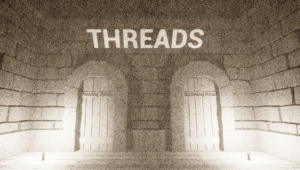
My first stop in Glasgow in January was the Glasgow Women’s Library, where I found Hugh V. McLachlan’s book The Kirk, Satan and Salem: A History of the Witches of Renfrewshire, which draws a connection between the 1692 Salem Witch Trials and those in Paisley a few years later. McLachlin and J. Kim Swales note striking similarities between A True Narrative of the Sufferings and Relief of a Young Girle (unattributed from 1698, about Christian Shaw), and A Brief and True Narrative Of some Remarkable Passages Relating to sundry Persons Afflicted by Witchcraft, at Salem Village… (by Rev. Deodat Lawson, published in Boston in 1692 and republished in 1693, London). Both texts centralize the behaviour of adolescent girls leading to people in their respective villages being convicted of witchcraft. This characteristic sets the Paisley trials apart from most other witch persecution cases in Scotland, which focused on accusations between adults [4].
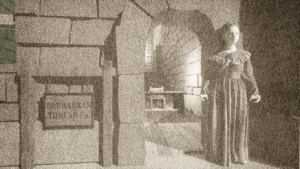 The result of my artistic research at GSA is the Threads exhibition, which draws particular inspiration from Paisley. The accusations began when 11-year-old Christian Shaw displayed unusual symptoms; Shaw remains central to the story, though her role was amplified by those in positions of power. The ensuing trials resulted in the deaths of eight people; Catherine Campbell, Margaret Lang, Margaret Fulton, Agnes Naismith, John Lindsay, John Lindsay of Barloch, James Lindsay, and John Reid [4]. Shaw would grow up to become Widow Millar and start Bargarran Thread, one of the first thread businesses in the town that would birth Coats and Clark [5].
The Threads exhibition in July 2026 includes a first-person game and a series of textiles. In the game, two levels provide different experiences of the Renfrewshire story. In the Proving Room (1697), the player is accused of witchcraft and is called by the Minister and Shaw’s Father to touch young Christian’s arm to gauge her reaction. Will it expose him as guilty or innocent? In the Spinning Room (1722), the player is on her first day on the job at Bargarran Thread. The company owner welcomes her and invites her to spin. Strange goings-on in the factory remind her of years past when a tragedy occurred in the town. Development of the Threads game began when I worked with undergraduate research students at my home institution, University of North Carolina Asheville, to prototype interactivity, characters, and gameplay. In Scotland, I built and compiled assets, recorded audio in the SIT sound studio, and coded the game. GSA colleagues got involved with 3D modeling and voice acting, and acapella group Muldoon’s Picnic composed and sang Spinn’ the Threid o’ Life, the auditory thread throughout the game.
The tapestries in Threads reference those who died in the Paisley witch trials, but more broadly represent the mostly unnamed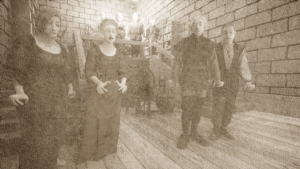 people executed in all of the Scottish witch trials. The woven blanket is an AI-prompt generated and artist-composited digital weaving that imagines what a portrait of Christian Miller as a businesswoman may have looked like. I created the Young Christian Shaw weaving on the TC-2 Jacquard loom in GSA’s Weaving studios. The image was compiled from screenshots of the Threads game and edited in Photoshop and Pointcarre weaving software. Links between textile production, witch accusations, and modern computing weave their way through the Threads body of work [6].
Dr. Victoria Bradbury is Associate Professor of New Media at University of North Carolina Asheville and the 2026 US–UK Fulbright Commission Distinguished Scholar at The Glasgow School of Art. She specializes in interactive and immersive media storytelling and is the 10th great-granddaughter of Mary Perkins Bradbury who was wrongly convicted of witchcraft in 1692 Salem, Massachusetts. She thanks the US-UK Fulbright Commission and Glasgow School of Art for their support of this research.
Works Cited:
[1] Julian Goodare, Lauren Martin, Joyce Millar and Louise Yeoman, The Survey of Scottish Witchcraft, https://witches.hca.ed.ac.uk/
[2] Mitchell, Claire, and Zoe Venditozzi. How to Kill a Witch: A Guide for the Patriarchy. Octopus Books, 2025. Pg. 24, 172.
[3] https://www.witchesofscotland.com/about
[4] McLachlan, Hugh V., ed. The Kirk, Satan and Salem: A History of the Witches of Renfrewshire. Grimsay Press, 2022. Pg. 459, 460, 479-484.
[5] https://paisleythreadmill.co.uk/history/
[6] https://blurringartandlife.com/vb/threads.html