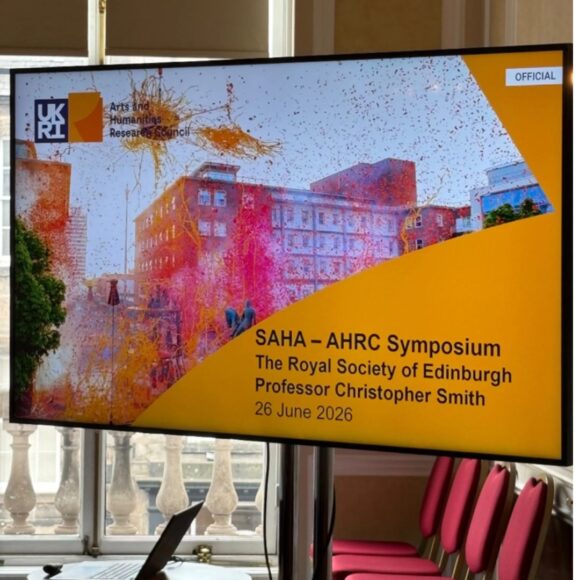
On Friday, June 26th, the Scottish Arts and Humanities Alliance (SAHA) unveiled its latest report, Languages in a Global Scotland. It was produced by SAHA’s Languages Working Group, chaired by Professor Catherine O’Leary, and draws on expertise from across the Scottish higher education sector. The report argues that languages and intercultural studies are key to the creation of a Global Scotland for the benefit of all.
Languages in a Global Scotland acknowledges the impact of the 2016 United Kingdom European Union membership referendum on languages and intercultural understanding across the UK. It recognises that the public view of languages in Scottish society is often a negative one, linked to misperceptions about their lack of value for jobs and the economy, the dominance of English as a world language, and the emergence of AI. This is despite significant evidence demonstrating the importance of languages and cultural understanding to national security, community well-being, economic growth, and global competitiveness.
The situation in Scotland echoes the findings of several other recent UK studies (HEPI, 2025: British Academy, 2020, 2023 and 2025; British Council, 2017, 2021, 2025 and 2026, etc.). Some language programs in the UK higher education sector, including in Scotland, have been reduced or closed, and this has an impact on the future of language provision at all levels.
The report provides a snapshot of key areas, illustrating the current situation in the context of modern languages, Gaelic, Scots, and British Sign Language in Scottish Higher Education; the challenge of teacher recruitment; multilingualism; languages and soft power; and the challenges and benefits of AI. It is an invitation to political, business, educational and community stakeholders to join SAHA in a conversation about how language and cultural skills can work for Scottish society.
Chair of the report, the Languages Working group, and SAHA co-Chair Professor O’Leary said:
“Scotland is increasingly linguistically and culturally diverse with many students who have home heritage and community languages. This is a strength to be built on.
“Those of us working in language departments know the importance of languages and cultural understanding to national security, community wellbeing, economic growth, and global competitiveness. But it’s not enough for us to know this, we need to challenge the negative perceptions that exist around languages and tell a fuller story of their value to the prosperity of Scotland.
“The recommendations in the report make suggestions for the future, but we need to collaborate to make them work.
“The Scottish Arts and Humanities Alliance and its Languages Working Group hopes that the sector, stakeholders and politicians will enjoy reading the report and will see it as an invitation to join SAHA in a discussion about next steps, to recognise the importance of languages and cultural understanding in a Scotland that embraces both tradition and progress, and that draws on both for its strong, proud identity and its global ambition.”
The report is available online on saha.scot.
Notes to editors:
Physical copies may be available on request.
More information about the working group can be found here
For enquiries, please use this contact form
SAHA is an alliance of 12 Scottish Higher Education Institutions, the Scottish Graduate School of Arts and Humanities (SGSAH), and the Royal Society of Edinburgh, which acts as the host institution, which acts as a collective and united voice for the sector and promotes the arts and humanities in Scotland in the context of higher education, and to explicitly articulate their value for social, cultural, and economic wellbeing.