2026 marks 225 years since the first ever Burns Supper took place at Burns Cottage in Alloway, Ayrshire on the fifth anniversary of the death of Robert Burns. What began as a local celebration of the life of Scotland’s national bard has since developed into a global tradition – one that continues to evolve and be adapted in new and exciting ways by communities across the world.
In recognition of this anniversary, we at the University of Glasgow’s Centre for Robert Burns Studies (CRBS) are delighted to have launched our newest research project, titled ‘The Burns Supper at 225 Years: Scottish Tradition, Global Reinvention’. As its name suggests, the idea behind this project is to capture and analyse the diverse ways in which the Burns Supper continues to be maintained, but also adapted and modified, by different groups and cultures.
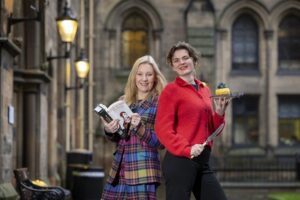
Image Credit: Martin Shields. Read more about the launch of ‘The Burns Supper at 225 Years’ here.
Haggis pakora, haggis poutine, and the Gung Haggis Fat Choy celebrations that take place annually in Vancouver (combining Burns Night and Chinese New Year since 1998) offer just a few examples of the multicultural dynamism by which the Burns Supper is now so often characterised. These instances of fusion and innovation combine with the enduring Scottish traditional roots of the Burns Supper to confirm it as a prime example of global living heritage.
The launch of the ‘Inventories of Living Heritage in the UK’ by the Department for Digital, Culture, Media, and Sport in December 2025 (following the UK’s ratification of the 2003 UNESCO Convention for the Safeguarding of the Intangible Cultural Heritage in 2024), makes the ‘Burns Supper at 225 Years’ project particularly timely. It is our hope that, pending inclusion of the Burns Supper as a social practice in the first UK Inventory of Living Heritage, the Burns Supper will in time be ratified by UNESCO’s ‘Representative List of the Intangible Cultural Heritage of Humanity’.
In December 2025, we were excited to launch officially our survey of the Burns Supper at 225 Years. This survey is open to all, and in it we’re interested in hearing about what people are eating, drinking, reading, reciting, singing, dancing, wearing, and performing at their Burns Suppers this year. Where applicable, we’re also excited to hear participants’ reflections on the multicultural aspects of their celebrations, and what these tell us about the ongoing diversification of this Scottish tradition.
Responses to the survey will form the basis of a new digital map of Burns Suppers taking place globally, which we hope to launch in July 2026, to coincide with the timing of the inaugural Burns Supper in 1801. All survey participants are invited to share photographs, videos, and recipes from their Burns Suppers, and these will be included on the map too. The new map will build on the extensive research carried out between 2020 and 2021 by CRBS researchers to produce the existing Interactive Map of Burns Suppers (and also the mural pictured below); its contents will help to produce a new archive of the Burns Supper as Living Heritage. Both the new map and archive will provide an important step towards achieving UNESCO inscription of the Burns Supper as Intangible Cultural Heritage.
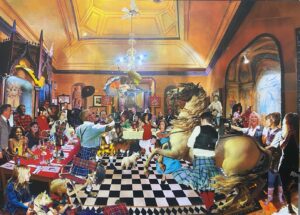
Image credit: David Mach, ‘The Flying Haggis’, 2021. Produced in collaboration with CRBS as part of ‘The Burns Supper in History and Today’ project (2020-21).
To access and complete our survey (which takes on average just 7 minutes), please visit the CRBS website. We are also on LinkedIn, BlueSky, and Facebook – give us a follow and tag us using #BurnsSupper225 to keep in touch.
If any questions arise, don’t hesitate to contact Professor Pauline Mackay and Dr Cleo O’Callaghan Yeoman at arts-burnssupper@glasgow.ac.uk. We look forward to hearing from you!
Dr Cleo O’Callaghan Yeoman received her AHRC-funded PhD in English Studies from the University of Stirling (with co-supervision from the Universities of Glasgow and Edinburgh) in 2025. She now works as a Research Associate at the University of Glasgow’s Centre for Robert Burns Studies. Her research interests include Scottish Romanticism, the novel, theories of improvement, and the history of reading. She has published in The Burney Journal, Library and Information History, the Journal of Scottish Philosophy, and the Burns Chronicle, and is also the current Early Career Officer of the British Association for Romantic Studies.